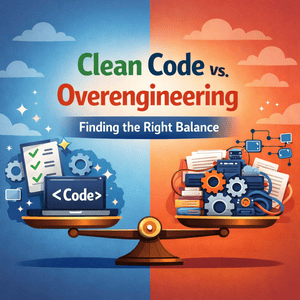
Clean Code vs. Overengineering: Finding the Right Balance
Clean code is exactly what it sounds like—code that is easy to read, understand, and maintain. It’s not about being clever. It’s about being clear.
Think of clean code like a well-organized workspace. Everything has a purpose, nothing is out of place, and anyone can jump in and understand what’s going on without confusion.
Key Characteristics of Clean Code
Readability First
Your code should read almost like plain English. Anyone reviewing it should quickly understand the intent.
var totalPrice = quantity * pricePerUnit / discountRate;
No guessing. No confusion.
Single Responsibility Principle
Every function or class should do one thing well.
This concept is rooted in Single Responsibility Principle and is a core part of writing maintainable systems.
Meaningful Naming
Names matter more than most developers think.
Bad:
var data = GetData();
Better:
var customerOrders = GetCustomerOrders();
Consistency
Stick to naming conventions, formatting, and structure across your entire codebase.
Minimal Complexity
Simple logic always beats clever logic. If someone has to “figure it out,” it’s already too complex.
What Is Overengineering?

Overengineering happens when developers introduce unnecessary complexity into a system.
It usually comes from good intentions—trying to future-proof the application—but ends up doing more harm than good.
Common Signs of Overengineering
Too Many Layers
If you need to jump through multiple classes just to trace one function, something’s off.
Premature Optimization
Optimizing performance before there’s an actual problem.
A better approach:
Measure first, then optimize.
Overuse of Design Patterns
Patterns like Factory, Strategy, or Builder are powerful—but not always necessary.
These concepts originate from Design Patterns: Elements of Reusable Object-Oriented Software, but they’re tools—not requirements.
“What If” Development
Building features for scenarios that might never happen.
Clean Code vs Overengineering: The Core Difference
| Clean Code | Overengineering |
|---|---|
| Simple and readable | Complex and abstract |
| Solves current problems | Solves hypothetical problems |
| Easy to maintain | Hard to understand |
| Focused design | Overly flexible design |
| Minimal dependencies | Excessive layers |
At its core, the difference is this:
👉 Clean code focuses on clarity and simplicity
👉 Overengineering focuses on anticipation and complexity
Why Developers Fall Into Overengineering

Understanding why overengineering happens is key to avoiding it.
Trying to Impress
Complex systems can feel like a way to showcase skill—but simplicity is harder to master.
Fear of Future Changes
Developers often try to prepare for every possible scenario.
Misunderstanding Best Practices
Best practices are guidelines—not rules. Misusing them leads to unnecessary complexity.
Lack of Maintenance Experience
Writing code is easy. Maintaining it over time is where reality hits.
The Real Cost of Overengineering
Overengineering doesn’t just make code look complicated—it has real consequences.
Slower Development
More layers = more time coding, debugging, and testing.
Harder Onboarding
New developers struggle to understand overly complex systems.
Increased Bugs
More complexity means more points of failure.
Reduced Agility
Even small changes become difficult.
How to Find the Right Balance

Finding the balance between clean code and overengineering is what separates good developers from great ones.
Follow YAGNI (You Aren’t Gonna Need It)
Don’t build something until you actually need it.
This principle is widely used in agile methodologies like Extreme Programming (XP).
Keep It Simple (KISS Principle)
Always ask: Can this be simpler?
KISS stands for:
Keep It Simple, Stupid
Build First, Then Refactor
Start with a simple solution. Improve it as requirements evolve.
Use Abstractions Only When Needed
Introduce abstraction only when patterns naturally emerge.
Code for Humans
Remember—your code will be read far more than it’s written.
Measure Before Scaling
Don’t optimize performance without real data.
Real-World Example: Simple vs Overengineered Code
Overengineered Version
Imagine multiple interfaces, factories, and dependency layers just to register a user.
Clean Code Version
public class UserService
{
    public void Register(User user)
    {
        Validate(user);
        Save(user);
    }
}
Simple. Clear. Maintainable.
When Abstraction Is Actually Necessary
Abstraction isn’t bad—it’s just often overused.
Use it when:
- You have multiple implementations
- You see repeated patterns
- The system is growing
- You need real flexibility
If none of these apply, keep it simple.
Practical Checklist Before Adding Complexity
Before writing more code, ask yourself:
- Do I actually need this right now?
- Is there a simpler solution?
- Will this make the code harder to read?
- Am I solving a real problem or guessing?
- Can I refactor later instead?
If you hesitate on any of these, you’re probably overengineering.
Why Clean Code Wins in the Long Run
Clean code isn’t just about aesthetics—it’s about longevity.
Well-written, simple code:
- Reduces bugs
- Speeds up development
- Improves collaboration
- Makes scaling easier
In real-world environments—especially in teams—clarity always beats cleverness.
Final Thoughts
Clean code and overengineering sit on opposite ends of the spectrum—but the goal isn’t to choose one over the other.
It’s to find the balance.
The best developers understand this:
The goal is not to write the smartest code—it’s to write the most understandable code.
Focus on solving real problems. Keep your code simple. Refactor when needed.
Because at the end of the day, great software isn’t defined by how complex it is—it’s defined by how easy it is to work with.
If you want a quick look at the top cybersecurity threats shaping 2026—especially with AI-driven attacks and evolving vulnerabilities,
👉 click here for more details